
Handout
Minimizing the Concurrent Training Interference Effect
Therapy Insights
Member Exclusive


Print Resource
— US Letter — 2 pages
Population:
AdultDiscipline:
OTDiagnosis:
Sports and ExerciseReferences:
- Schumann, M., Feuerbacher, J. F., Sünkeler, M., Freitag, N., Rønnestad, B., Doma, K., & Lundberg, T. (2021). Compatibility of concurrent aerobic and strength training for skeletal muscle size and function: An updated systematic review and meta-analysis.
- Petré, H., Hemmingsson, E., Rosdahl, H., & Psilander, N. (2021). Development of maximal dynamic strength during concurrent resistance and endurance training in untrained, moderately trained, and trained individuals: A systematic review and meta-analysis. Sports Medicine, 51(5), 991-1010.
- Gäbler, M., Prieske, O., Hortobágyi, T., & Granacher, U. (2018). The effects of concurrent strength and endurance training on physical fitness and athletic performance in youth: A systematic review and meta-analysis. Frontiers in Physiology, 9.
- Murlasits, Z., Kneffel, Z., & Thalib, L. (2017). The physiological effects of concurrent strength and endurance training sequence: A systematic review and meta-analysis. Journal of Sports Sciences, 36(11), 1212-1219.
- Robineau, J., Babault, N., Piscione, J., Lacome, M., & Bigard, A. X. (2016). Specific training effects of concurrent aerobic and strength exercises depend on recovery duration. Journal of Strength and Conditioning Research, 30(3), 672-683.
- Ghodrat, L., Razeghian Jahromi, I., Koushkie Jahromi, M., & Nemati, J. (2022). Effect of performing high-intensity interval training and resistance training on the same day vs. different days in women with type 2 diabetes. European Journal of Applied Physiology, 122(9), 2037-2047.
- Wilson, J. M., Marin, P. J., Rhea, M. R., Wilson, S. M., Loenneke, J. P., & Anderson, J. C. (2012). Concurrent training. Journal of Strength and Conditioning Research, 26(8), 2293-2307.
- Jones, T. W., Howatson, G., Russell, M., & French, D. N. (2016). Performance and endocrine responses to differing ratios of concurrent strength and endurance training. Journal of Strength and Conditioning Research, 30(3), 693-702.
- Fyfe, J. J., Bartlett, J. D., Hanson, E. D., Stepto, N. K., & Bishop, D. J. (2016). Endurance training intensity does not mediate interference to maximal lower-body strength gain during short-term concurrent training. Frontiers in Physiology, 7.
- Sousa, A. C., Neiva, H. P., Izquierdo, M., Cadore, E. L., Alves, A. R., & Marinho, D. A. (2019). Concurrent training and detraining: Brief review on the effect of exercise intensities. International Journal of Sports Medicine, 40(12), 747-755.
- Sabag, A., Najafi, A., Michael, S., Esgin, T., Halaki, M., & Hackett, D. (2018). The compatibility of concurrent high intensity interval training and resistance training for muscular strength and hypertrophy: A systematic review and meta-analysis. Journal of Sports Sciences, 36(21), 2472-2483.
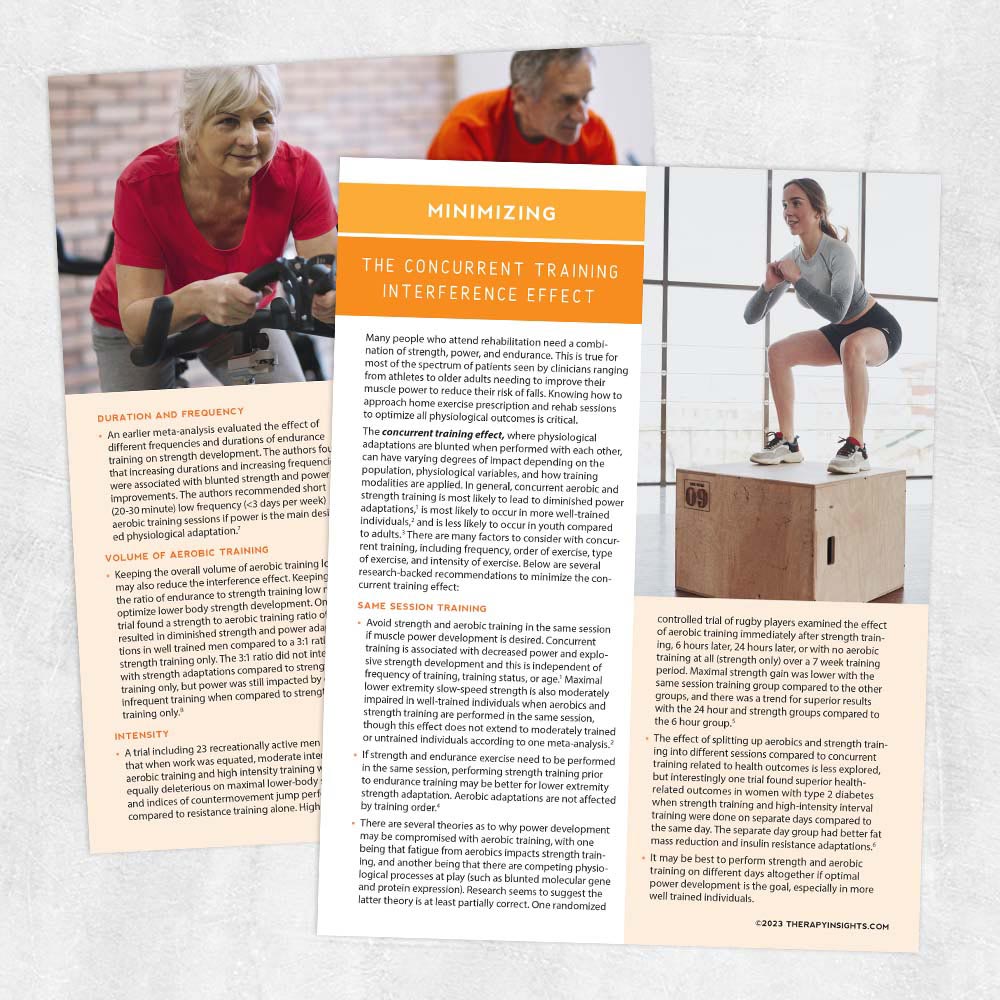
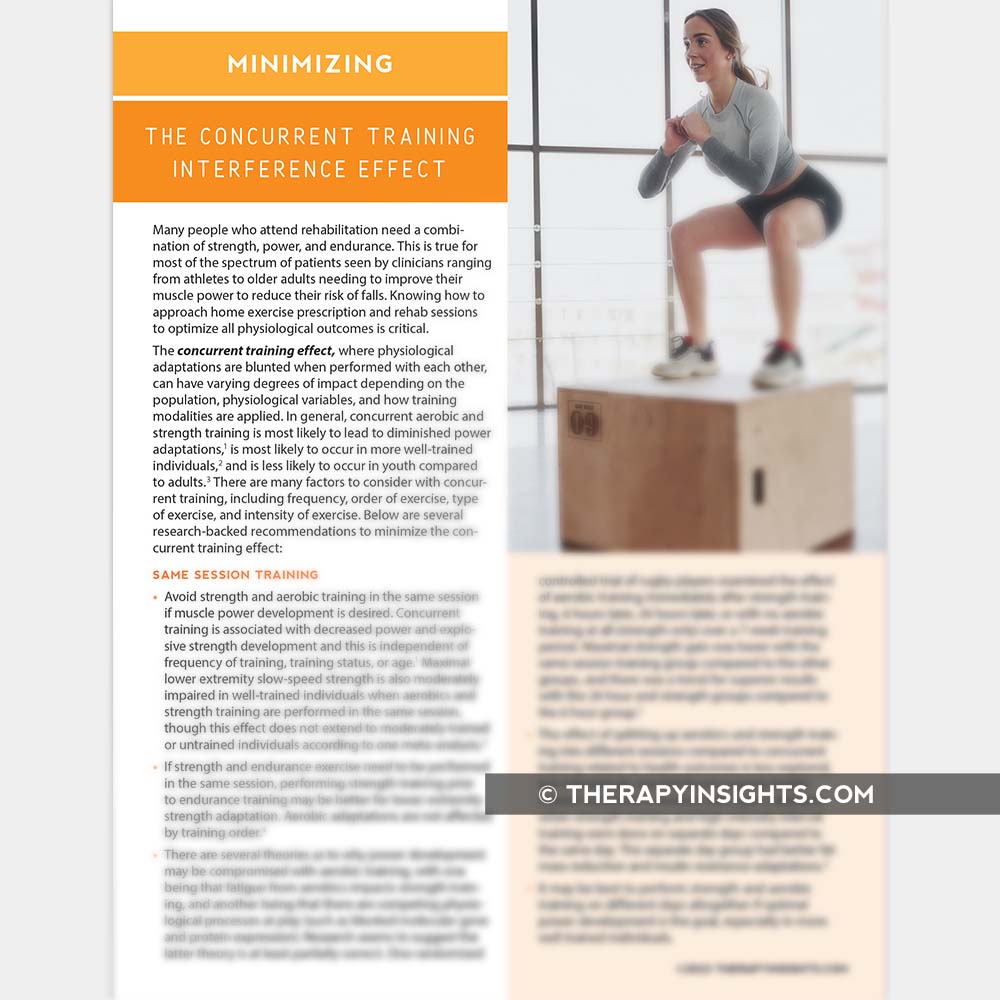
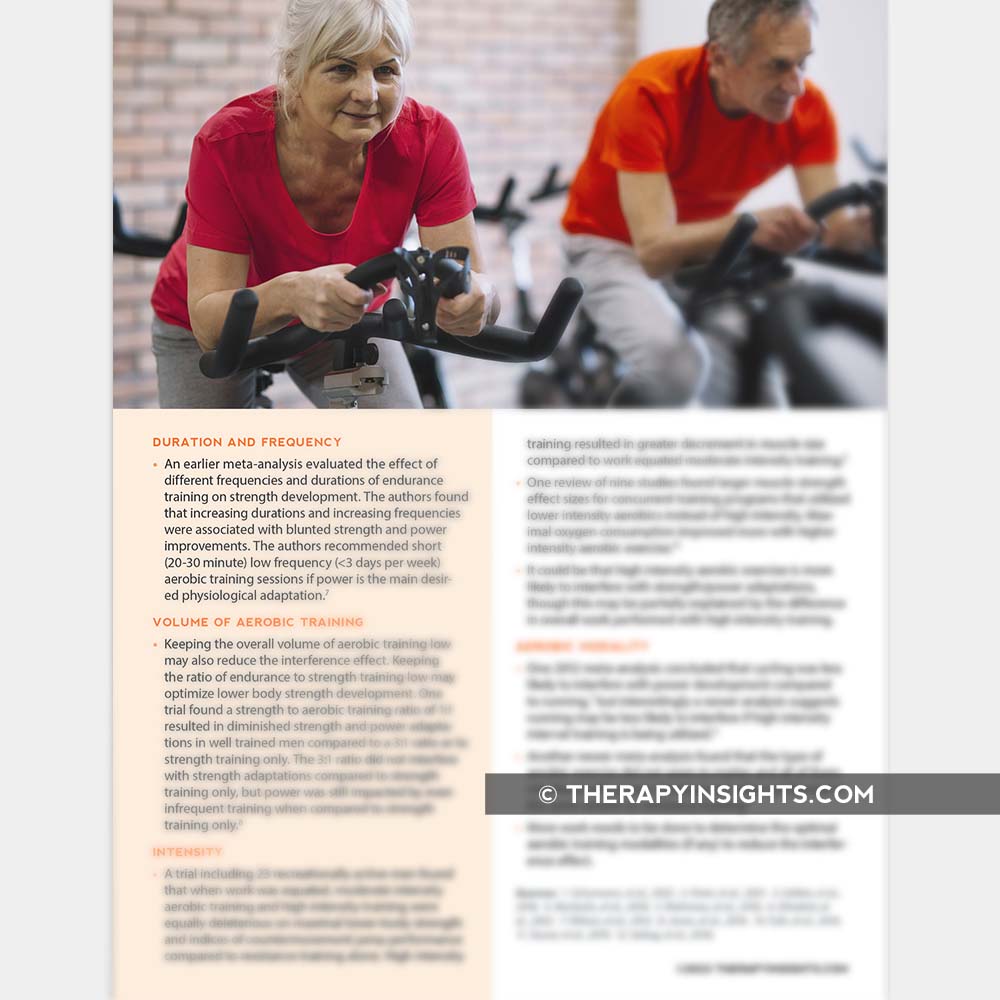
This resource is a guideline for clinicians who work with clients needing strength, power, and cardiovascular adaptations. It discusses strategies to minimize the concurrent training effect.
Want access to this printable resource and hundreds more? Subscribe to Therapy Insights.
Subscribe to get instant and easy access to handouts, therapy materials, and clinical tools so that you can spend your valuable time doing what you do best: Connecting with your patients and changing lives for the better.
Subscribe now
Already subscribed to Therapy Insights? Log in to access this member exclusive.
Related resources
Handout
Avoiding Red Lights: Pacing for Progress
Therapy Activity
Hockey Play-by-Play: Tracking Changing Information
Clinical Reference
Talking About Money After Illness or Injury: A Clinical Guide
Handout
Beyond Exercise: Fun Ways to Stay Active
Handout
Your Concussion Recovery Roadmap
Handout
Changes in Speech Fluency After a Neurologic Injury
Daily Resource Limit
There was an issue loading this asset. Please try again or contact customer support.

If you want to own this resource and save it to your device, it is also available for purchase (download) on Etsy.
View on Etsy