
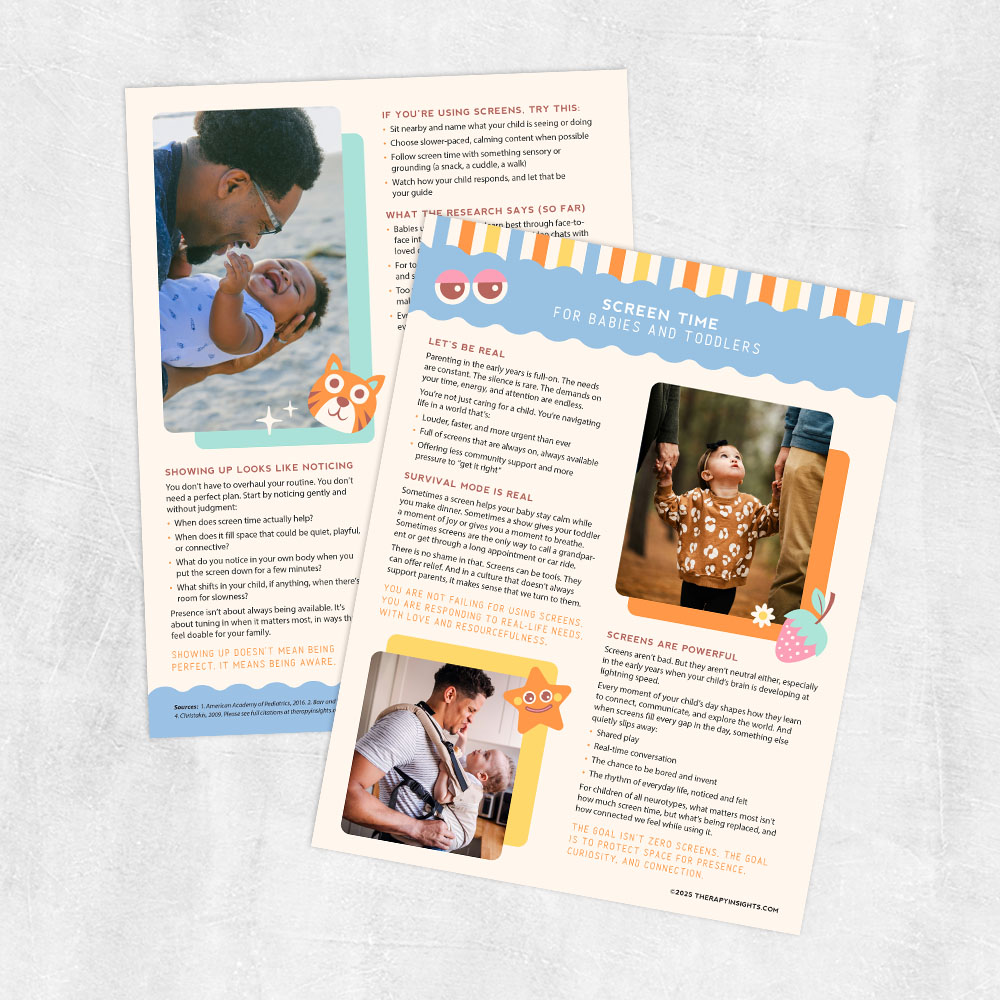
Screen Time for Babies and Toddlers


Population:
PediatricDiscipline:
OTSLPDiagnosis:
Executive FunctionLanguage DevelopmentSensoryReferences:
- American Academy of Pediatrics. (2016). Media and young minds. Pediatrics, 138(5), e20162591.
- Barr, R., & Linebarger, D. N. (2017). Media exposure during infancy and early childhood: The effects of content and context on learning and development. In R. Barr & D. N. Linebarger (Eds.), Media exposure during infancy and early childhood (pp. 1–24). Springer.
- McHarg, G., Williams, D., Bedford, R., & Gliga, T. (2023). Touchscreen play in toddlers is associated with reduced responsiveness to social cues. JAMA Network Open, 6(3), e235294.
- Christakis, D. A. (2009). The effects of infant media usage: What do we know and what should we learn? Acta Paediatrica, 98(1), 8–16.
This reflective handout supports parents of children ages birth to three in navigating screen time with clarity, compassion, and intention. Rather than prescribing limits, it invites meaningful awareness of how screens show up in daily life and what might be getting crowded out. This printable handout is for occupational therapists and speech-language pathologists working with pediatric patients, covering Executive Function, Language Development and Sensory. Print Resource, US Letter, 2 pages. Members can view and print it.
Use this resource when a patient, family, or colleague asks:
- How does screen time affect babies and toddlers?
- How much screen time is okay for young children?
Want access to this printable resource and hundreds more? Subscribe to Therapy Insights.
Subscribe to get instant and easy access to handouts, therapy materials, and clinical tools so that you can spend your valuable time doing what you do best: Connecting with your patients and changing lives for the better.
Already subscribed to Therapy Insights? Log in to access this member exclusive.
Related resources
Daily Resource Limit
There was an issue loading this asset. Please try again or contact customer support.